 Fort Lauderdale Criminal Attorney Blog


Florida domestic violence laws are written in such a way that almost always: someone is going to jail. Understanding what happens next can determine everything about how this ends.
Florida’s domestic violence statutes mean anyone arrested on such charges cannot be released on bond before their First Appearance hearing — no matter how much money you have, no matter how mild the incident. That hearing happens within 24 hours of arrest. As a Fort Lauderdale domestic violence defense lawyer, I emphasize to anyone facing charges that the decisions you make before and during that hearing can shape the entire case. Your wisest course of action is to hire an experienced lawyer to help you through it.
Why Florida Officers Almost Always Arrest Someone
Florida Statute Section 741.2901 sets out one of the most aggressive domestic violence enforcement frameworks in the United States. It does not merely permit arrest; it creates a presumption that arrest is appropriate whenever an officer has probable cause to believe domestic violence has occurred, even if the alleged victim does not want anyone arrested, even if no visible injury exists, and even if the incident appears minor by any objective measure.
The statute explicitly instructs that “it is the intent of the Legislature that domestic violence be treated as a criminal act rather than a private family matter.” That legislative intent has real-world consequences:
- The victim cannot “drop the charges.” Charges are brought by the State of Florida, not by the alleged victim. Even if the complaining party recants entirely, the prosecution can proceed (and often does) on other evidence including 911 recordings, officer observations, and photographs
- Officer discretion is severely limited. If an officer has probable cause — meaning they believe domestic battery is more likely than not to have occurred — arrest is the required response in most circumstances. Mediating and leaving is generally not an option
- Both parties can be arrested. Florida law allows for dual arrests when officers find mutual aggression. Both people in the home can be taken into custody simultaneously
- Prior relationship matters, not current status. Florida’s domestic violence statutes cover current and former spouses, people who share a child, current or former household members, and people in dating relationships — regardless of whether they still live together
The practical effect is that a call to 911, made in anger, made by a neighbor, or made in a moment that quickly de-escalated, can trigger an arrest that neither party wants and that cannot be undone by the time cooler heads prevail. Understanding this is the first step to navigating what comes next.
The First 24 Hours: A Timeline
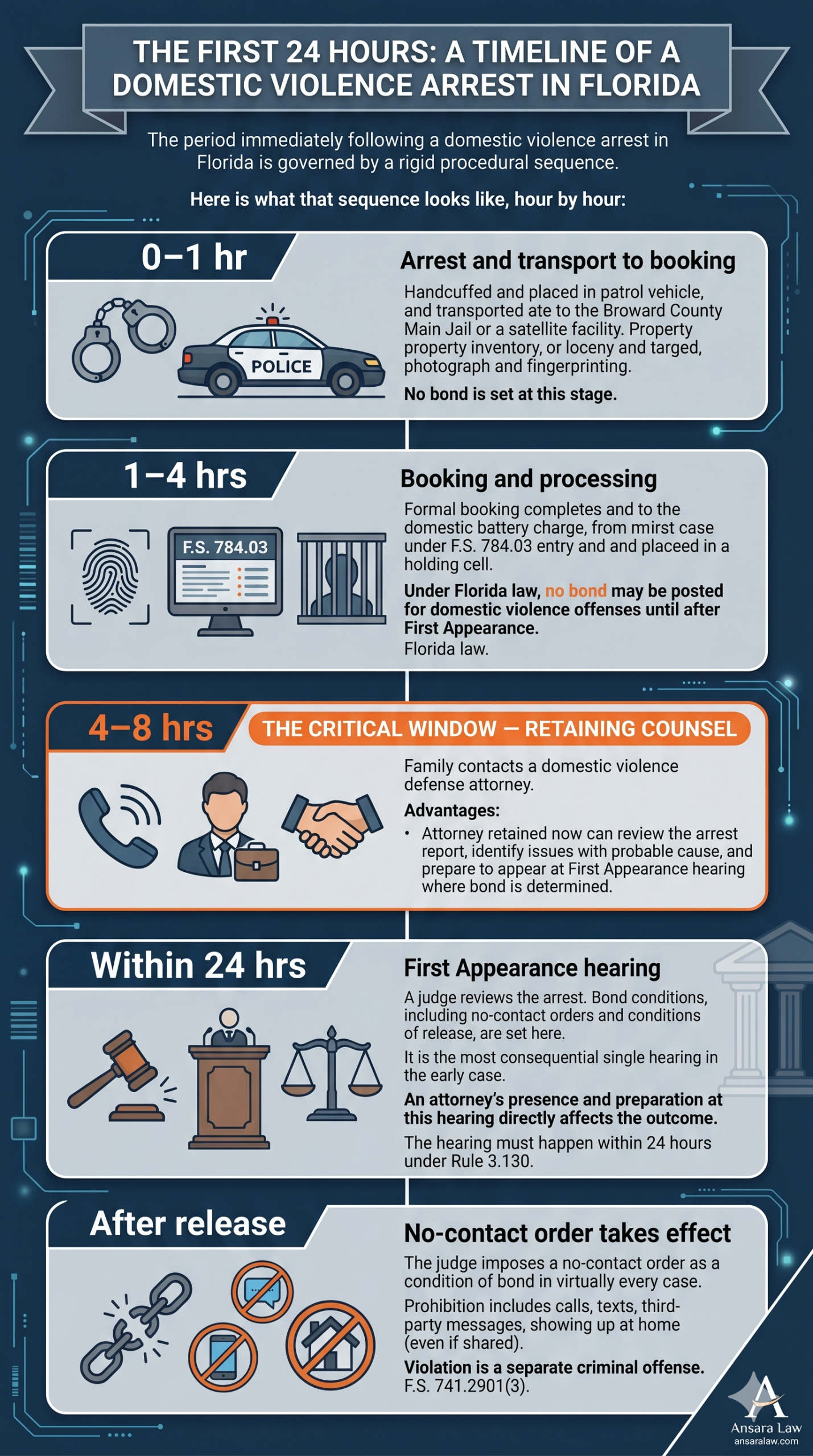
The period immediately following a domestic violence arrest in Florida is governed by a rigid procedural sequence.
The No-Bond Hold: Why You Cannot Just Post Bail
This is the piece that catches families most off guard. In most criminal arrests in Florida, a bond amount is set at booking, and the arrested person can be released within hours by paying that bond or using a bondsman. Domestic violence arrests do not work this way.
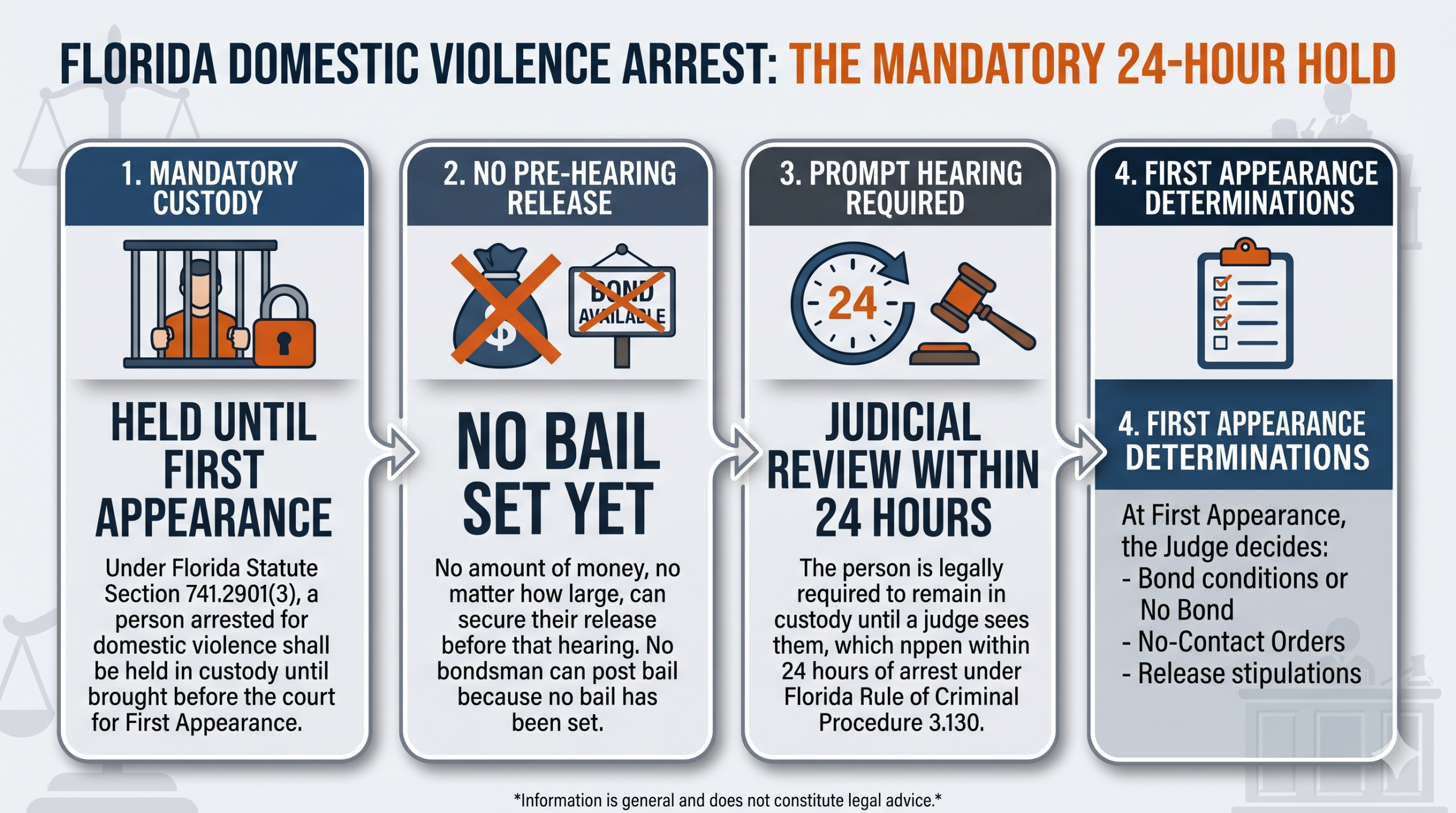
Under Florida Statute Section 741.2901(3), a person arrested for domestic violence shall be held in custody until brought before the court for First Appearance. No amount of money, no matter how large, can secure their release before that hearing. No bondsman can post bail because no bail has been set. The person is legally required to remain in custody until a judge sees them, which must happen within 24 hours of arrest under Florida Rule of Criminal Procedure 3.130.
What Happens at First Appearance
First Appearance is a brief hearing , often only a few minutes long, but its consequences are not brief at all. In a domestic violence case, the judge at First Appearance decides three things that will govern the next weeks or months of the defendant’s life:
1. Whether to set bond, and how much
The judge reviews the arrest report and considers the nature of the alleged offense, the defendant’s criminal history, their ties to the community, and any argument made by counsel. For a first-offense domestic battery with no injury and no prior record, a skilled attorney can often argue for a reasonable bond. For cases involving alleged strangulation, serious injury, violation of a prior injunction, or a pattern of violence, the judge has wide discretion to set a high bond or deny bond entirely.
2. Conditions of release
Even when bond is granted, the judge will impose conditions. In virtually every domestic violence case, this includes a no-contact order prohibiting any communication with the alleged victim. It may also include GPS monitoring, surrender of firearms, requirement to remain in Broward County, alcohol prohibition, and mandatory check-ins with pretrial services.
3. The no-contact order
This is the condition that creates the most immediate practical disruption for families. If the defendant and the alleged victim live together, which is common, the no-contact order means the defendant cannot return home. They cannot call their own spouse. They cannot pick up their children. They cannot arrange for anyone to relay a message. Violating a no-contact order is a first-degree misdemeanor punishable by up to one year in jail, separate from the underlying domestic battery charge.
The no-contact order is not automatically permanent. After First Appearance, a defense attorney can file a motion to modify the no-contact condition if both parties wish to resume contact and the court finds it appropriate. This is often possible in first-offense cases without significant injuries, particularly when the alleged victim submits an affidavit requesting modification. However, this process takes time and requires careful legal handling — it cannot be done informally.
What a Defendant’s Family Members Can Do
If your partner, spouse, or family member has just been arrested for domestic violence, the hours before First Appearance are the most important of the entire legal process.
Here is typically what needs to happen:
- Contact a domestic violence defense attorney immediately. Do not wait until morning. Do not wait to see how things develop. An attorney retained before First Appearance can review the arrest report, communicate with the prosecutor’s office, and appear at the hearing prepared to argue for reasonable bond and workable release conditions.
- Do not attempt to contact the person in custody. Before an attorney is retained and advises you otherwise, limit contact attempts. Calls to jail are recorded. Any statements made on a recorded jail line — by the defendant or by family members calling in — are fully available to prosecutors and are routinely used at trial.
- Do not contact the alleged victim directly. If you are a family member of the defendant, avoid calling or texting the alleged victim to “work things out” before the hearing. Pressure on an alleged victim — even well-intentioned — can be characterized as witness tampering or intimidation, which are serious separate offenses.
- Gather information for the attorney. Write down everything you know about what happened — the timeline, who was present, what was said, whether anyone was injured, and whether there is any history of prior incidents or prior calls to police. Your attorney needs this information as quickly as possible.
- Locate and preserve any evidence. Photographs, videos, text message threads, social media posts, and any other digital evidence from around the time of the incident should be preserved immediately. Screenshot conversations. Do not delete anything. Evidence can disappear quickly, and defense attorneys need it.
- Identify potential witnesses. Were there neighbors who heard or saw what happened? Friends or family members who spoke to either party that evening? Witnesses who can speak to the nature of the relationship? A list of potential witnesses, with their contact information, is invaluable to the defense.
Why a “Complaining Witness” Recanting Rarely Ends the Case
One of the most persistent misconceptions about domestic violence cases is that if the alleged victim changes their mind and doesn’t want to press charges, the case goes away. This is almost never true in Florida, and misunderstanding it leads families to make costly strategic errors.
Florida trains its prosecutors to build domestic violence cases that can survive without the alleged victim’s cooperation. This is by design because the legislature recognized that complaining witnesses in domestic violence cases often recant under pressure, out of financial dependence, out of genuine reconciliation, or out of fear of what a prosecution will do to their family. The State’s response was to build cases that don’t depend on testimony from the alleged victim.
- 911 call recording — often the most powerful evidence at trial
- Body camera footage from responding officers
- Photographs of injuries taken at the scene
- Officer testimony about observations, demeanor, and statements made
- Medical records if treatment was sought
- Text and social media messages between the parties
- Prior 911 calls or incident reports involving the same parties
- Challenges the 911 call’s reliability, context, and hearsay admissibility
- Analyzes body cam footage for inconsistencies with the arrest report
- Retains expert witnesses to contest injury causation or severity
- Challenges officer testimony through cross-examination on training and procedure
- Files motions to suppress improperly obtained evidence
- Presents the defendant’s account of the events with supporting context
- Pursues diversion programs and alternatives to conviction for eligible clients
The point is not that a recanting witness is useless to the defense. A complaining witness who submits a sworn affidavit of non-prosecution, or who testifies consistently with the defense account, can significantly affect the State’s case and its willingness to offer favorable resolution. But recantation alone is not a strategy. It must be part of a comprehensive defense approach managed by an experienced attorney.
Florida’s Diversion Programs: A Path That Protects the Record
For eligible defendants, typically first-time offenders with no prior domestic violence history, no serious injury, and no use of a weapon, Florida offers a pre-trial intervention program for domestic violence cases. Completion of this program, which typically includes a 26-week batterers’ intervention course, counseling, and community service, can result in the charges being dropped entirely.
Unlike a conviction, successful completion of a pre-trial diversion program for domestic battery may allow the defendant to have the arrest record sealed — preserving their employment, housing, and professional licensing prospects. This option is only available to eligible defendants, and pursuing it requires careful navigation of the diversion process from the beginning of the case. Missteps early in the proceedings can close this door permanently.
Not every defendant qualifies, and not every case should resolve through diversion; sometimes the facts and the law support fighting the charge outright. But understanding that diversion exists, and that it represents a fundamentally different outcome than a plea or a conviction, is something every family facing a first domestic battery arrest should discuss with their attorney immediately.
Call Fort Lauderdale Criminal Defense Attorney Richard Ansara at (954) 761-4011. Serving Broward County.
More Blog Entries:
HB 277 and the Surge in Electronic Monitoring: What Domestic Violence Defendants Need to Know, March 20, 2026, Fort Lauderdale Criminal Defense Lawyer Blog
