Articles Tagged with domestic violence defense

As a Fort Lauderdale criminal defense attorney who regularly represents clients facing domestic violence charges, I often hear variations of the same anguished statement: “I didn’t mean to hurt them.” It’s a deeply human reaction—the immediate regret following an incident that has spiraled out of control, leaving both the alleged victim and the accused dealing with serious legal consequences.Broward domestic violence defense lawyer

This statement reveals something important about how many people understand their own actions. They recognize that harm occurred, but they genuinely didn’t intend for things to escalate to that point. Perhaps an argument became heated, emotions ran high, and physical contact occurred in the chaos. Perhaps they were trying to prevent their partner from leaving during an argument, or they grabbed something without thinking and it made contact with someone else.

The critical legal question becomes: Does lack of intent to cause harm provide a valid defense to domestic violence charges? As a Broward domestic violence defense lawyer, I will always be honest with my clients about the reality of their situation. And the fact is, while  a defendant’s intent is a key element in many criminal charges (including domestic violence offenses), that doesn’t necessarily mean lack of intent to cause harm will be the basis for the best defense.

Understanding Florida’s Domestic Violence Statute

Under Florida Statute § 741.28, “domestic violence” is defined as any assault, aggravated assault, battery, aggravated battery, sexual assault, sexual battery, stalking, aggravated stalking, kidnapping, false imprisonment, or any criminal offense resulting in physical injury or death of one family or household member by another family or household member.

Notice what this definition does—it incorporates other criminal offenses, most commonly battery, into the domestic violence framework when those offenses occur between family or household members. This means we must understand both the underlying criminal charge (like battery) and how the domestic relationship aspect affects the case.

Family or household members include spouses, former spouses, persons related by blood or marriage, persons currently living together or who have lived together in the past as a family, and persons who share a child in common, regardless of whether they were ever married.

Why Intent (Mens Rea) Matters in Criminal Law

In criminal law, mens rea — Latin for “guilty mind” — refers to the mental state or intent required to establish criminal liability. Different crimes require different levels of intent, and this distinction is fundamental to our justice system. It’s why we differentiate between murder and manslaughter, between theft and accidentally taking someone else’s property.

For battery charges, which form the foundation of most domestic violence cases in Florida, intent is indeed a required element. Under Florida Statute § 784.03, battery occurs when a person:

  1. Actually and intentionally touches or strikes another person against their will, or
  2. Intentionally causes bodily harm to another person

The word “intentionally” appears prominently in this statute, which might initially seem encouraging if you’re saying “I didn’t mean to hurt them.” However — and this is crucial — the intent requirement is more nuanced than most people realize.

The Critical Distinction: Intent to Touch vs. Intent to Harm

Here’s where the law becomes counterintuitive for many defendants: the prosecution does not need to prove you intended to cause harm or injury.

Florida courts have been clear on this point. For a battery conviction, the state only needs to establish that you intended the contact itself (the touching, striking, or grabbing) not that you intended for that contact to result in injury or harm. Florida courts have ruled the defendant need only intend to touch or strike a person without their consent. As such, the State is not required to show the defendant intended harm or injury.

This means that even if you genuinely didn’t mean for your partner to get hurt, if you intentionally:

  • Grabbed their arm to stop them from leaving
  • Pushed them during an argument
  • Threw an object in their direction
  • Made any physical contact that they did not consent to

…you may have committed battery, even if injury wasn’t your goal and even if no significant injury occurred.

The touching must be intentional and against the other person’s will. Truly accidental contact — like bumping into someone in a doorway — doesn’t constitute battery. But once you cross the line into intentional, non-consensual touching, the fact that you didn’t want anyone to get hurt may not be a complete defense.

Why “I Didn’t Mean to Hurt Them” Usually Isn’t Enough

When clients tell me they didn’t mean to cause harm, they’re often making what lawyers call a “specific intent” argument. They’re saying they didn’t specifically intend the harmful result. Unfortunately, battery is what we call a “general intent” crime. This means the prosecution only needs to prove you intended to commit the act (the touching) that resulted in the offense, not that you intended all of the consequences that flowed from that act.criminal defense lawyer Fort Lauderdale

Consider this common scenario: During a heated argument, you grab your partner’s wrist to prevent them from walking away. You don’t intend to hurt them; you just want them to stay and finish the conversation. But the grab is forceful enough to leave a bruise. Your partner calls the police.

In this situation, saying, “I didn’t mean to hurt them,” actually hurts your defense. It acknowledges the intentional touching but focuses on your lack of intent regarding the injury. However, because you intentionally grabbed their wrist against their will, you’ve satisfied the legal definition of battery. The bruise becomes evidence of the offense, not a required element that you had to specifically intend.

That’s why your Broward domestic violence defense lawyer may advise you against arguing a lack of intent to cause harm, as that alone is rarely a winning strategy in these cases.

So What Defense Strategies Actually Work?

The good news is that experienced domestic violence defense attorneys have numerous strategic approaches that may be more effective than simply arguing you didn’t mean to cause harm. The right strategy depends on the specific facts of your case, the available evidence, and your goals (whether that’s complete dismissal, reduced charges, or minimizing consequences). Continue reading

If you’re facing domestic violence charges in Fort Lauderdale, you might be focused solely on avoiding jail time or probation. While these immediate penalties are certainly serious, the collateral consequences of a domestic violence conviction can affect your life for years—or even decades—after your case concludes. Understanding these hidden penalties is crucial when deciding whether to hire a Fort Lauderdale criminal defense attorney or attempt to represent yourself.Fort Lauderdale criminal defense lawyer

Loss of Gun Rights: A Federal Prohibition

One of the most significant collateral consequences of a domestic violence conviction is the permanent loss of your Second Amendment rights. Under federal law, specifically the Lautenberg Amendment to the Gun Control Act, anyone convicted of a misdemeanor crime of domestic violence is prohibited from possessing firearms or ammunition for life. This isn’t just a Florida restriction—it’s a federal prohibition that follows you nationwide.

For law enforcement officers, military personnel, or security professionals in Fort Lauderdale, this consequence alone can end a career. Even recreational gun owners face a lifetime ban with no possibility of restoration.

A Fort Lauderdale criminal defense attorney can explore alternatives like pretrial diversion programs or negotiate reduced charges that don’t trigger this federal firearm prohibition.

Professional Licensing Complications

Florida’s professional licensing boards take domestic violence convictions seriously. Under Florida Statute § 741.30, domestic violence is defined as any assault, battery, or other criminal offense resulting in physical injury or death between family or household members. A conviction under this statute can jeopardize professional licenses for:

  • Healthcare workers (doctors, nurses, EMTs)
  • Attorneys and legal professionals
  • Real estate agents and brokers
  • Teachers and educators
  • Financial professionals and accountants

Many licensing boards consider domestic violence a crime of moral turpitude, which can result in license suspension, revocation, or denial of renewal. Even if you avoid jail time, losing your professional license could devastate your career and earning potential. At The Ansara Law Firm, we understand how to present your case in a way that protects not just your freedom, but your livelihood.

Immigration Consequences for Non-Citizens

Continue reading

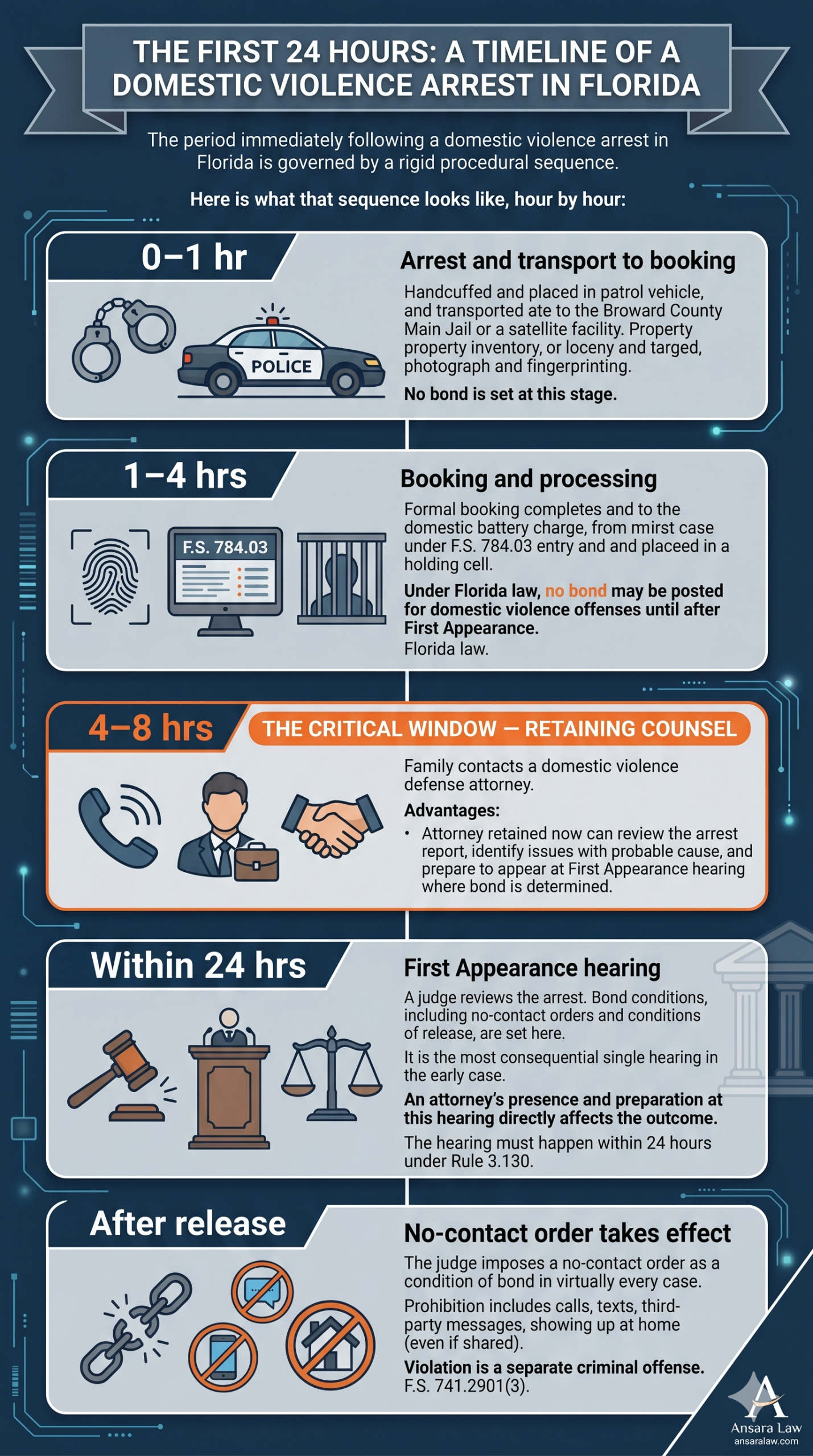
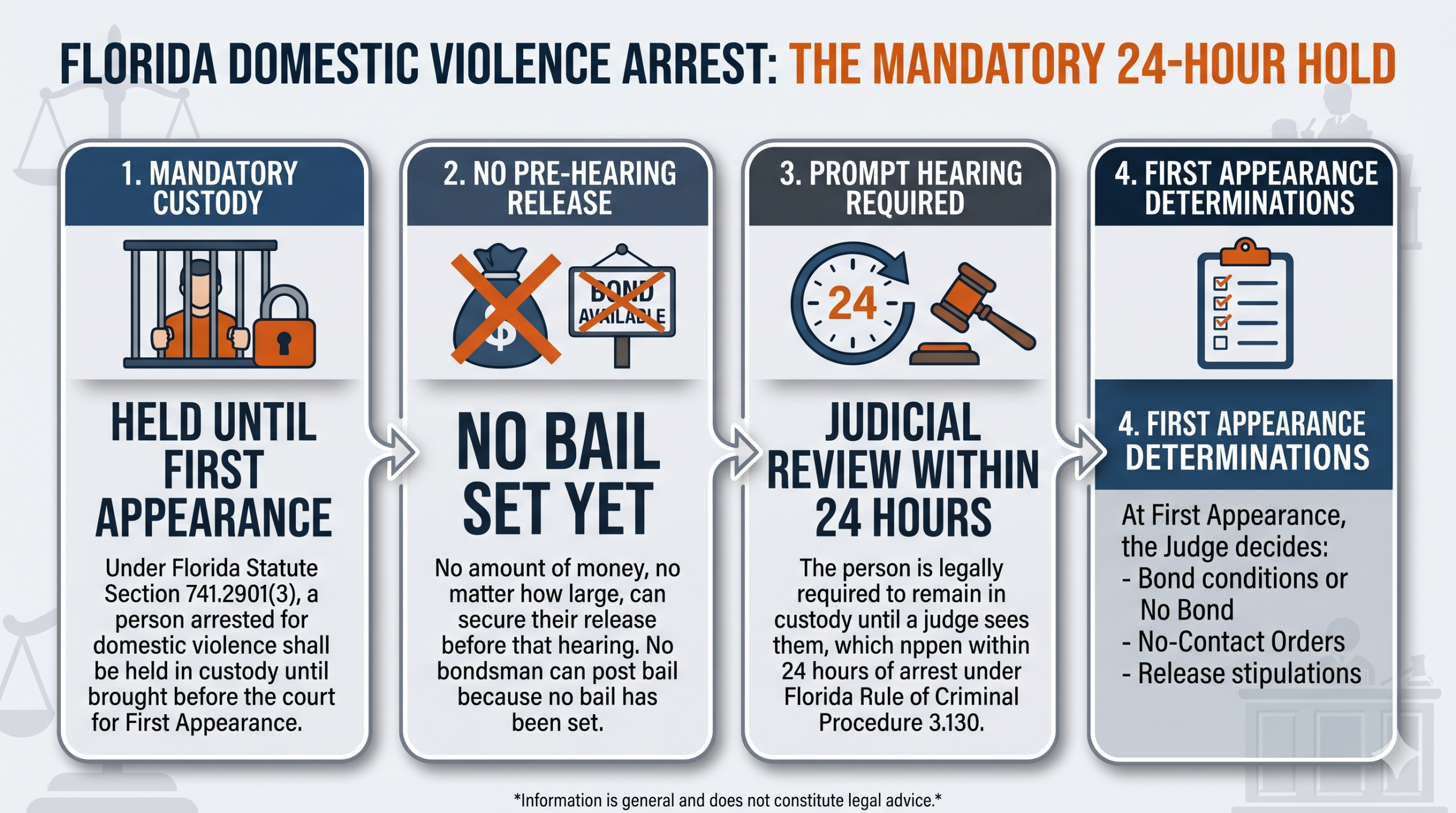
Being arrested for domestic violence in Broward County can turn your world upside down in an instant. But here’s something many people don’t realize: an arrest doesn’t automatically mean you’ll face criminal charges. Understanding how the charging process works—and when charges can be dropped—is important when your freedom and future is at stake. Broward domestic violence lawyer

The Reality Behind Domestic Violence Arrests vs. Charges

In Florida, domestic violence isn’t a standalone crime but rather an enhancement that applies to various offenses when they occur between family or household members. Under Florida Statute § 741.28, domestic violence can include actions such as assault, battery, sexual assault, stalking, kidnapping, or any criminal offense resulting in physical injury or death when committed by one family or household member against another.

When law enforcement responds to a domestic violence call in Broward County, they often make arrests based on probable cause—a relatively low standard that merely requires reasonable belief that a crime occurred. However, as a Broward domestic violence lawyer can explain, this arrest is just the beginning of a complex legal process, not the end of your story.

Who Really Decides Whether Charges Get Filed?

Contrary to popular belief, victims don’t “press charges” in domestic violence cases. In Broward County, that decision rests entirely with the State Attorney’s Office for the 17th Judicial Circuit. Prosecutors review the evidence independently and make charging decisions based on what they believe they can prove in court beyond a reasonable doubt.

This prosecutorial discretion means that even when an arrest occurs, the state attorney may decide not to file formal charges for various reasons:

  • Insufficient evidence to prove the case beyond a reasonable doubt
  • Witness credibility issues
  • Constitutional violations during the investigation
  • Evidence that contradicts the initial police report

Broward domestic violence defense lawyerThe Unique Nature of Domestic Violence Prosecutions

Broward domestic violence cases differ significantly from other criminal matters, particularly regarding victim cooperation. Under Florida Statute § 90.804(2)(a), prosecutors can sometimes proceed without the alleged victim’s testimony by using hearsay exceptions, such as excited utterances made during 911 calls or statements to responding officers.

However, victim non-cooperation still presents substantial challenges for prosecutors. When alleged victims recant their statements, refuse to testify, or become uncooperative, it often weakens the state’s case considerably. Unlike other crimes where multiple independent witnesses might exist, domestic violence typically occurs in private settings with limited evidence beyond conflicting accounts.

How Early Legal Intervention Can Prevent Charges

The window between arrest and formal charging—typically 21 days in Florida under Florida Rule of Criminal Procedure § 3.134—represents a critical opportunity. During this period, an experienced domestic violence defense attorney can:

  • Conduct Independent Investigation. Gathering evidence that contradicts the state’s narrative, including witness statements, medical records, photographs, and electronic communications that provide context or alternative explanations.
  • Challenge Evidence Collection. Identifying potential Fourth Amendment violations, Miranda rights violations, or other constitutional issues that could render evidence inadmissible.
  • Communicate with Prosecutors. Presenting exculpatory evidence and legal arguments directly to the prosecutor’s office before charging decisions are made. This proactive approach often proves more effective than reactive defense strategies.
  • Address Victim Concerns. When appropriate and ethical, helping facilitate communication between parties to clarify misunderstandings or address underlying issues that led to the incident.

The Strategic Advantage of Early Representation

Prosecutors make charging decisions based on the evidence available to them at the time. If they only see the police report and initial witness statements, they’re working with an incomplete picture. Early legal intervention allows defense attorneys to present the full story before charges are filed.

Consider this scenario: Police arrest someone after responding to a domestic disturbance call where the alleged victim has visible injuries. The initial report might paint a clear picture of guilt. However, a Fort Lauderdale defense attorney’s investigation might reveal:

  • The injuries resulted from an accident during a verbal argument.
  • The alleged victim was the initial aggressor.
  • Both parties had been drinking, affecting their ability to accurately recall events.
  • Text messages or social media posts contradict the alleged victim’s statement.

Presenting this evidence before charges are filed can prevent the case from ever reaching the courtroom.

When Charges Can Be Dropped After Filing

Even after formal charges are filed, dismissal remains possible under certain circumstances:

  • Lack of Evidence. If new evidence emerges that undermines the prosecution’s case or if key evidence is ruled inadmissible.
  • Victim Non-Cooperation. While prosecutors can proceed without victim cooperation, practical challenges may lead to dismissal when victims refuse to testify and other evidence is insufficient.
  • Constitutional Violations, Evidence obtained through illegal searches, improper interrogations, or other rights violations may be excluded, potentially forcing dismissal.
  • Prosecutorial Discretion. Prosecutors may dismiss charges in the interest of justice, particularly in cases involving minimal harm, first-time offenders, or where prosecution wouldn’t serve the public interest.

The No-Contact Order ComplicationBroward domestic violence defense lawyer


Florida courts typically issue no-contact orders as a condition of bond in domestic violence cases, prohibiting contact between the defendant and alleged victim. These orders can significantly impact families and relationships, making early resolution even more crucial. Under Florida Statute § 741.30, violating these orders constitutes a separate criminal offense, creating additional legal jeopardy.

Building Your Defense Strategy

Continue reading

As we’re living in a digital age, text messages and social media posts have become central to domestic violence prosecutions. These forms of communication are commonly used to corroborate allegations, establish intent, or prove a pattern of behavior. This digital paper trail can be scrutinized and used against you in court – and they come up a lot especially in Fort Lauderdale domestic violence cases. Broward criminal defense lawyer talks text messages as evidence in domestic violence cases

If you’re facing domestic violence charges in Broward County, understanding how digital communications are handled as evidence can be important to building an effective defense – and potentially keeping you out of trouble in the future.

The Role of Digital Evidence in Domestic Violence Cases

Text messages, emails, and social media interactions are increasingly relied upon in Florida domestic violence cases to support allegations of abuse, harassment, or threats. These communications can be used in various ways, such as:

  • Establishing Intent or Threats. A text message threatening harm can be used to demonstrate the accused’s intent.
  • Documenting Patterns of Behavior. Repeated texts or social media messages can be presented as evidence of harassment or stalking.
  • Corroborating Testimony. Digital evidence can back up a complainant’s version of events, especially when physical evidence is limited.

While this evidence can seem to create open-and-shut cases, the truth is it’s not always as straightforward as prosecutors may suggest. As experienced Broward criminal defense lawyers can explain, messages can easily be taken out of context, manipulated, or misinterpreted – especially given that slang terms are now evolving at a faster rate than ever (thanks in large part to social media). All of this opens the door for a skilled defense attorney to challenge their validity.

Legal Standards for Admissibility

To be used as evidence in a Broward criminal case, digital communications must meet specific legal standards for admissibility:

  1. Authentication.
    Under the rules of evidence, prosecutors must authenticate digital messages by proving they originated from the accused. The Florida Supreme Court has repeatedly emphasized the need for reliable evidence to establish the authenticity of electronic communication. Text messages may be admitted as evidence, but if they lack proper authentication, they may be excluded.
  2. Relevance.
    Messages must be directly relevant to the charges at hand. Courts often weigh whether the probative value of the evidence outweighs its potential for unfair prejudice.
  3. Integrity.
    The integrity of the evidence must be preserved. Altered or incomplete messages can be excluded as inadmissible.

Common Defenses Against Digital Evidence

An experienced Fort Lauderdale criminal defense attorney can use several strategies to challenge the admissibility or interpretation of digital evidence: Continue reading

One of the most common questions I get as a criminal defense attorney representing clients against Broward domestic violence allegations is, “Can the charges be dropped? What if the victim no longer wants to press charges?”Broward domestic violence lawyer

While it might seem straightforward that a case should be dropped if the alleged victim changes their mind, the reality is far more complex. In Florida, domestic violence cases are treated seriously, and decisions to prosecute are ultimately made by the state — not the alleged victim.

While this is technically true in pretty much all criminal cases, prosecutorial discretion in domestic violence cases very often errs on the side of moving forward with the case even when it’s against the alleged victim’s wishes. That’s because it’s coercion and manipulation are well-known patterns in domestic violence cases. It’s true that the state’s case may be weaker if the victim won’t cooperate, but that doesn’t mean they can’t still win.

Can Domestic Violence Charges Be Dropped?

In Florida, domestic violence charges are brought by the state. That means that once an arrest is made, the case is in the hands of the prosecutor. The alleged victim’s wishes are taken into consideration, but they do not have the power to “drop” the charges themselves. Even if the alleged victim no longer wants to pursue the case, the state attorney’s office may still choose to move forward with prosecution.

Prosecutorial Discretion

Florida operates under what is known as prosecutorial discretion. This means that after reviewing the evidence, the prosecutor decides whether or not to continue pursuing charges.

Domestic violence cases, in particular, are treated with caution due to concerns about the safety of the alleged victim and the possibility of coercion. Prosecutors are trained to recognize situations where an alleged victim might feel pressured to recant their story or withdraw their desire to prosecute.

The State of Florida has a vested interest in preventing domestic violence and protecting victims, so even if the alleged victim refuses to testify or wants to drop the case, the prosecutor may proceed.

The prosecution can rely on other forms of evidence, such as: Continue reading

Although society tends to view domestic violence as a one-sided crime, the reality is often a bit messier than that. It’s not unusual for both sides to be physical with each other. Yet law enforcement in Florida are statutorily urged to identify and arrest just one primary aggressor.Fort Lauderdale domestic violence defense lawyer

One can argue mutual combat or self-defense in a Broward domestic violence case – but these approaches are risky. As our Fort Lauderdale criminal defense lawyer can explain, self-defense is an affirmative defense – meaning you admit to the accused action, but argue it justified to avoid the legal affect it would otherwise have. Yes, the violent act occurred, but it was reasonably necessary in order to prevent the other person’s imminent use of unlawful force against themselves or someone else. According to F.S. 776.012, there is no duty to retreat. Further, as noted in F.S. 776.103, a person who is in their own home or vehicle is presumed by law to have a reasonable fear of imminent death or bodily harm if the alleged victim unlawfully entered or remained or attempted to remove another person against their will. Of course, in domestic situations, the question will be whether entry was unlawful – which it would not be if the residence is shared.

Florida has relatively strong self-defense statutes that protect one’s right to fight off an attacker in the face of immediate danger. However, courts expect solid evidence of that imminent threat. This is much more straightforward in situations where a stranger enters the home. In cases of domestic violence, self-defense is tougher to prove.

A Florida domestic violence injunction has the potential to significantly impact the respondent for years to come. An injunction will show up on background checks, impacting your ability to obtain certain types of employment, travel freedoms, clearance for certain government jobs, and your right to own a firearm and ammunition. Any violations are considered criminal and can result in arrest and prosecution.Broward domestic violence defense

Once you have a permanent domestic violence injunction against you, it can last indefinitely – removable only if you petition the court and successfully prove a material change in circumstances that removes the claimant’s previously reasonable continuing fear of becoming a victim of domestic violence. Filing a motion with the court asking for dissolution of a Florida domestic violence injunction is best done with the assistance of an experienced domestic violence defense attorney.

As illustrated in the recent case of Bak v. Bak before Florida’s Fourth District Court of Appeals, fighting for dissolution of a domestic violence injunction can take years – decades, even. But the fact that it’s still worth it to do so even after all those years just goes to further underscore the importance of putting up a strong defense against having them issued in the first place.

The Bak case goes all the way back to the summer of 1999, when the former wife alleged her then-husband was abusive toward her. The judge granted a temporary injunction (which isn’t difficult to obtain in Florida, as it only requires testimony and evidence from the petitioner). A couple weeks later, a permanent injunction was filed, and the pair divorced shortly thereafter.

Thirteen years passed. In 2012, the husband asked the court to have the injunction dissolved, arguing that changed circumstances had made it equitable to do so. As noted by the court, success in this argument would require the moving party to show that the scenario underlying the injunction no longer exists so that continuation of the injunction no longer serves a valid purpose (as pointed out in the 2011 Fla. 1st DCA case of Alkhoury v. Alkhoury). The request was denied. Two years later, he again requested an end to the injunction – and was again denied. In that ruling, the judge cited the ex-wife’s reasonable continuing fear based on the fact that their minor child still lived at her home. Another five years passed. He filed a third request to have the Florida domestic violence injunction dissolved. Again, the trial court denied his request. But instead of accepting this decision as final, he appealed – and prevailed.

According to the 4th DCA, the former husband made a number of compelling arguments, including: Continue reading

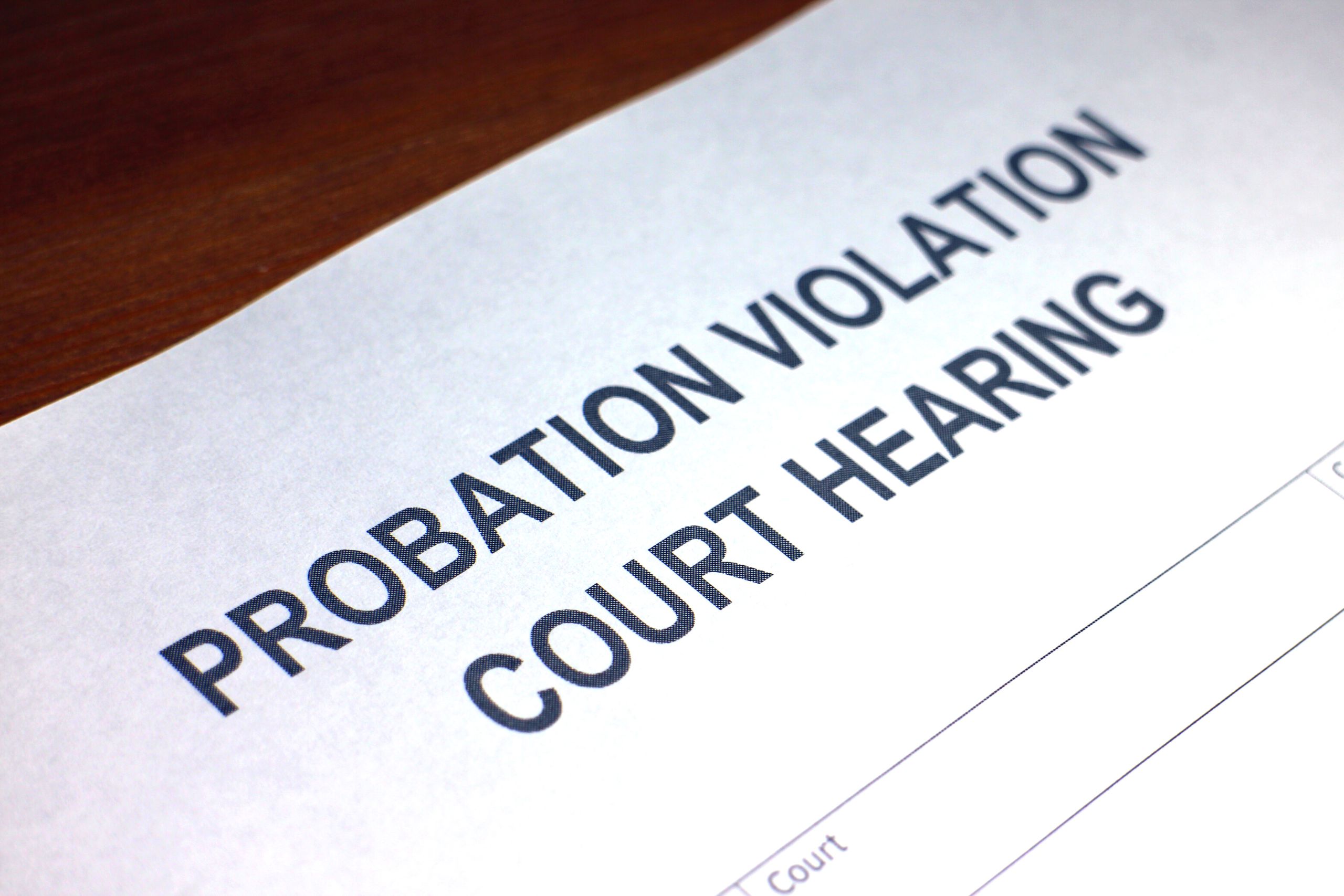
If you are arrested on a Fort Lauderdale domestic violence charge while on probation, it may result in harsher penalties – and the need for a strong defense strategy. Fort Lauderdale criminal defense

Probation is a form of alternative punishment that allows individuals convicted of an offense to fulfill the terms of a sentence while outside prison or jail. The oversight of a probation office or officer is supposed to serve the function of public safety, while allowing the offender the opportunity to work and contribute to society – in the hopes of rehabilitation and possibly victim restoration. The conditions of probation vary depending on the underlying offense, criminal history of the individual, and the judge who handed down the sentence. However, most terms of probation require the defendant to abide by all local, state, and federal laws.

When a new offense is committed by someone on probation, that person not only faces potential consequences for the new offense, but additional penalties for a probation violation.

Florida’s probation violation statute is F.S. 948.06.

While a criminal conviction may require proof beyond a reasonable doubt, probation violations aren’t held to that same proof burden standard. The probation officer/prosecutor only needs to show you violated the terms of your probation by a proof standard of “a preponderance of the evidence.” In layman’s terms, that means you more likely than not violated the probation rules.

As our Broward domestic violence defense lawyers can explain, you might evade a criminal conviction for the new offense but still be found to have violated your probation. And in that situation, you might be given the maximum penalty for the original underlying offense (the one for which you were on probation in the first place).

This is why it is so important if you’re accused of a probation violation to seek immediate counsel from a criminal defense attorney. Continue reading

If you are arrested in a Broward domestic violence case, you may be wondering what evidence the state might use against you.Fort Lauderdale domestic violence

As experienced Fort Lauderdale criminal defense attorneys, we know at the outset exactly the sorts of things prosecutors are going to be deep diving for to make their case.

Just like in any Florida criminal case, the burden of proof rests with the prosecution to prove in court that a crime was committed and that the accused is guilty of it. They are held to the highest standard of proof, which is beyond a reasonable doubt. Despite this, they have a fairly good conviction rate for domestic violence cases. According to one study by the Bureau of Justice Statistics, domestic violence sexual assault defendants are more likely to be prosecuted (89 percent) than non-domestic sexual assault defendants (73 percent). Domestic violence defendants were as likely to be prosecuted (66 percent) as non-domestic assault defendants (67 percent), but their conviction rates are substantially higher (87 percent versus 78 percent).

Elements of a Florida Domestic Violence Charge

If you’re facing a charges under F.S. 784.03 (battery and felony battery) what the prosecution basically has to show is:

  • The defendant actually and intentionally struck the other person against that person’s will.
  • The defendant intentionally caused bodily harm to another person.

If the prosecution is trying to prove a domestic violence crime specifically under F.S. 741.28, they will need to show the basic elements of the underlying crime (which can include assault, aggravated assault, battery, aggravated battery, sexual assault, sexual battery, stalking, aggravated stalking, kidnapping, false imprisonment or any criminal offense relating to physical injury) AND that the target was a family or household member. A family or household member can mean a spouse, people related to you by blood or marriage, people who reside together as if they are a family (or who have in the past), or someone with whom you share a child. Unless you share a child together, domestic violence can only be established if the defendant and accuser currently live together as a family or had in the past. Continue reading

Florida domestic violence criminal defense requires an attorney with extensive experience and a history of success in these cases. This is especially true considering there are increasingly serious consequences to domestic violence arrest and conviction, even outside of the criminal justice system. The professional damage, for instance, can be substantial. Fort Lauderdale domestic violence arrest

Recently, a report on the NFL’s evolving response to players’ alleged domestic violence made national headlines, though there isn’t great consistency. In one instance, a Minnesota Vikings cornerback accused of felony assault against his girlfriend hasn’t lost his job. He’s been kept on the roster after being selected in the first round of the NFL draft last year. By contrast, an undrafted offensive tackle from Seattle charged with felony assault was cut from the team the same day. This is despite the fact that he hasn’t even been convicted.

The football league’s approach to domestic violence cases has shifted since the Ray Rice elevator video involving his then-fiancée went viral in 2014. The number of second chances extended to players arrested for domestic violence has been significantly curbed. Prior to that incident, USA Today reported 85 percent of NFL players arrested or convicted in domestic violence cases got second chances from the league. Since the Rice video, that’s been reduced to about half – regardless of whether those individuals were later convicted or cleared. Continue reading

Contact Information